
How to Say Hungry in Japanese: 6 Words for Stomach
How to Say Hungry in Japanese and Different Words for Stomach
One of the fun and annoying aspects of Japanese is that there are so many ways to say anything: between different politeness levels and situational uses, things are never that simple.
So here is what most people will learn:
- I'm hungry. お腹が空きました (onaka ga sukimashita) - literally "stomach empty"
- stomach お腹 (onaka)
We use phrases for hungry to explain Japanese Conditional Statements (membership required)
So let's see what google translate has to say:
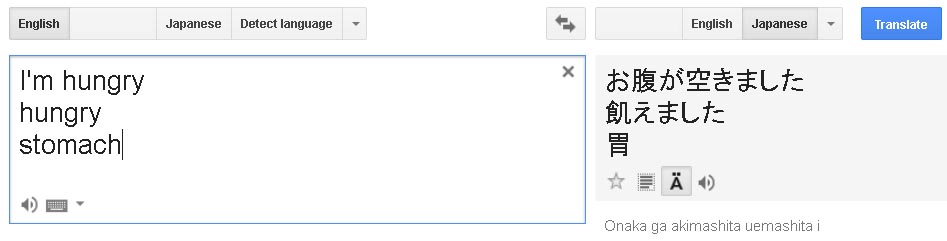
Left is what we input for translation. Right is the translation. Lower-right is the romanized pronunciation.
Well, that's not we expected...
We have the formal version - お腹が空きました pronounced as "onaka ga akimashita" which is wrong because it should be "onaka ga sukimashita"
So let's first learn different versions of I'm hungry:
- I'm hungry. お腹が減る (onaka ga heru)
- also: お腹が減った (onaka ga hetta)
- I'm very hungry お腹がぺこぺこ (onaka ga pekko pekko)
- or 腹がぺこぺこ (hara ga pekko pekko)
- hungry ハングリー (hanguri-)
- 胃 (i) literally stomach as in the organ
- 胃腸 (ichou) refers to the stomach and the intestines
- お腹 (onaka) polite form for belly
- 腹 (hara) this refers more to the gut or spiritual belly - notice the same kanji
- ストマック (sutomakku) English version of stomach
- 胃袋 (ibukuro) stomach / breadbasket
This is the most general form to say I'm hungry. You can also drop the が (ga) part in conversation to get お腹空いた (onaka suita).
We're going to move on because you already learned this version. (Notice that in this version, we use the past tense version of 空く (suku) - to be hungry.
Here's an important cultural note, お腹が空きました (onaka ga sukimashita) is rarely going to be used. This is because expressing you are hungry is rather a casual mannerism. If you are on business, you would say something more along the lines of:
Let's go to lunch. お昼に行きましょう。 (ohiru ni ikimashou)
This is the I'm hungry song!
Okay now let's get less formal:
This is a form you would use around your friends, although you can use the previous version as well. 減る (heru) means to reduce where as 空く (suku) means empty. But they mean the same thing when you're expressing hunger.
Now let's get even less formal
- I'm hungry! 腹減った (hara hetta)
This is not a form you would use often. Actually, Yuno would never use this form of "I'm hungry" as she feels it's too crude. It's not that women can't use it, but it is a bit masculine or childish. In the very first episode of One Piece, the pirates use this form.
This is a form you won't want to use.
- Starve 飢える (ueru)